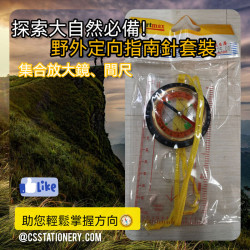

Compass and GPS are two common navigation tools that have obvious differences and advantages and disadvantages in positioning and navigation. In this article, we will compare these two tools to let readers know when they are suitable and how to use them.


First, let's introduce the compass. The compass is a tool that uses the direction of the Earth's magnetic field to indicate direction. It consists of a magnetic germanium and a bracket with one end of the magnet pointing towards the geomagnetic north pole. When the compass intersects the Earth's magnetic field, the magnetic germanium points to the north pole, indicating the direction of the north. The compass is commonly used in outdoor adventures, camping, and other activities because it does not require batteries and is not subject to electronic interference. However, the disadvantage of the compass is that it does not provide specific location information, only indicates direction. In addition, due to the influence of the Earth's magnetic field, it is possible that the compass will be disturbed by the magnetic field and pointed in the wrong direction.


Next, let's introduce GPS. GPS stands for Global Positioning System (GPS) and is a tool that uses satellite positioning technology to determine location. GPS consists of a set of satellites, ground control stations, and receivers. The receiver receives the signal transmitted by the satellite and calculates its own position. GPS has been widely used in navigation, flight, car navigation and other fields. The advantage of GPS over a compass is that it can provide precise location information, as well as navigation, speed, time, and more. In addition, GPS is not affected by the Earth's magnetic field and therefore not affected by magnetic field interference. However, the disadvantage of GPS is that it requires battery power, and there may be poor signal in environments such as valleys, tall buildings, etc.


To sum up, compass and GPS have their own advantages and disadvantages and are suitable for different scenarios. If you need to quickly determine the direction, the compass is a good choice. If you need precise location information and navigation, GPS is a better choice. In activities such as outdoor adventures, it is recommended to carry a compass as a backup tool in case of electronic device failure or poor signal. The use of GPS in areas such as car navigation and flying is more common. Whether using a compass or GPS, you need to learn the correct way to use it to ensure safety and accuracy.


MAK BEE


 Have experience in commercial sticker printing

 Understand the features of label machines and name stickers

 I believe sticker is helpful to our daily life.